
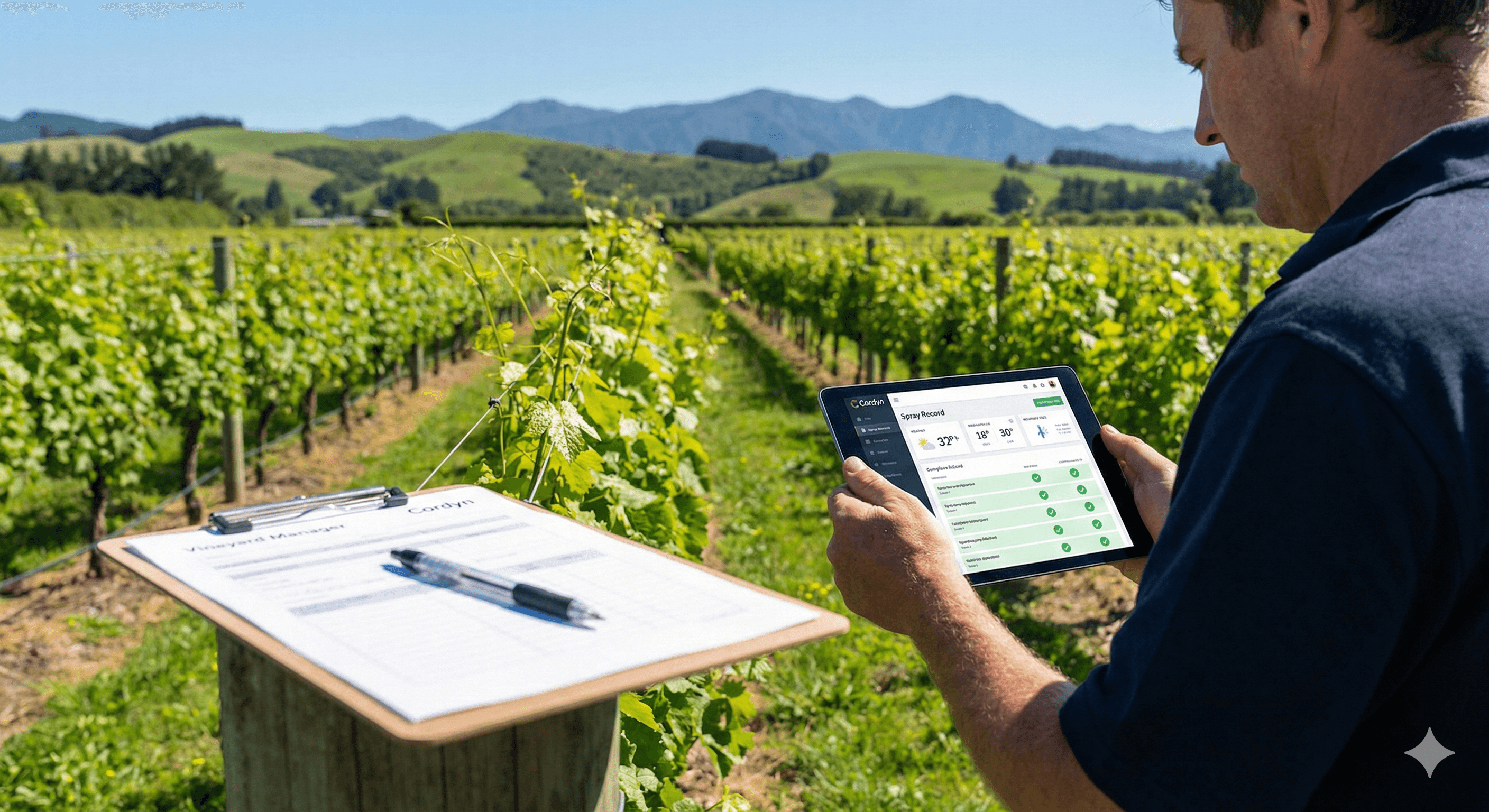
New Zealand's wine industry has built its global reputation on quality and sustainability. Behind every bottle is a trail of compliance documentation — spray applications, withholding periods, and audit records that prove the grapes were grown responsibly.
For most vineyard operations, this means spray diaries. And for most spray diaries, that still means paper forms, spreadsheets, or systems designed for broad agriculture rather than viticulture.
The compliance landscape
New Zealand vineyards face a web of overlapping requirements. SWNZ certification demands detailed spray records with product names, rates, and weather conditions. Export markets each set their own Pre-Harvest Intervals — a product might have a 14-day PHI for domestic sale but 35 days for the EU. Growsafe certification requires operators to demonstrate competency and proper record-keeping. NZS 8409:2021 sets the baseline for agrichemical management across all primary industries.
Meeting one standard is straightforward. Meeting all of them simultaneously, while running a commercial operation during the busiest weeks of the season, is where things get difficult.
Where paper falls short
The traditional spray diary works — until it doesn't. Common pain points include illegible handwriting discovered weeks later during an audit, calculations done on the back of a product label that can't be verified, weather data recorded from memory rather than actual conditions, and PHI tracking that relies on someone remembering to check before harvest.
These aren't failures of diligence. They're failures of systems that weren't designed for how vineyard work actually happens: outdoors, often in a hurry, with gloves on.
What digital records enable
A well-designed digital spray diary doesn't just replace paper — it removes entire categories of error. Product rates can be validated against label requirements before application. PHI calculations happen automatically across all relevant export markets. Weather data can be captured from on-site stations or nearby services. Audit trails are generated as work happens, not reconstructed afterwards.
The goal isn't to add complexity. It's to make compliance a byproduct of normal operations rather than a separate administrative burden.
Looking ahead
We're building Cordyn to address exactly these challenges — a spray diary platform designed specifically for New Zealand viticulture, with SWNZ and export compliance built in from the start.
More details coming soon. If you'd like to be notified when we launch, get in touch.