
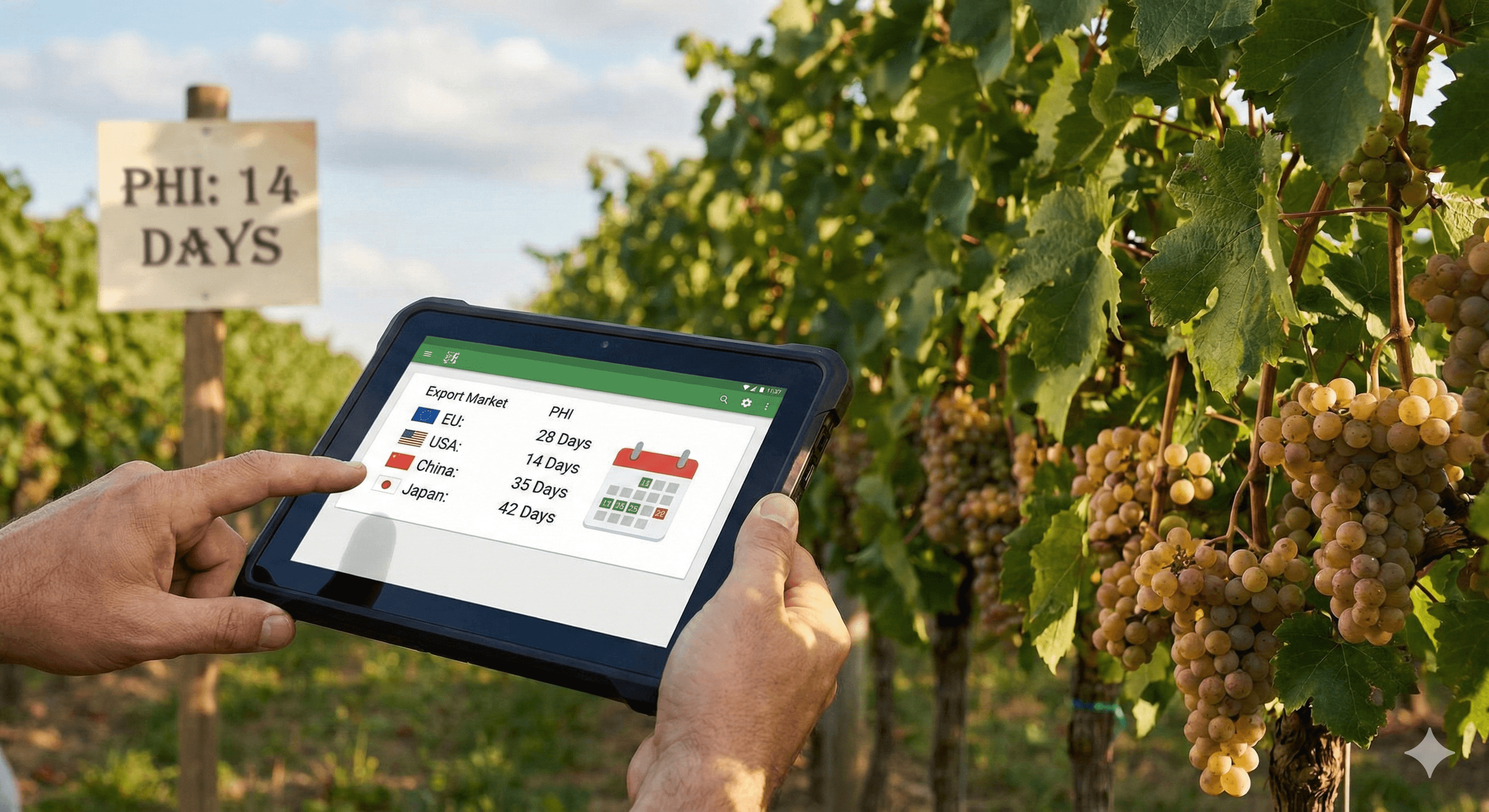
Every agrichemical product sold in New Zealand comes with a Pre-Harvest Interval — the minimum number of days between the last application and harvest. Follow the label, wait the required days, and you're compliant.
Except when you're not.
The export market complication
New Zealand wine goes everywhere. The EU, UK, US, Australia, China, Japan, and a dozen other markets each maintain their own Maximum Residue Limits for pesticides. When your MRLs differ, your effective PHI differs too.
A fungicide might be registered in New Zealand with a 14-day withholding period. That same product, applied to grapes destined for the EU, might require 28 days to meet their stricter residue limits. For Japan, it could be 35 days — or the product might not be permitted at all.
This isn't theoretical. It's the calculation every export-focused vineyard makes before every late-season spray application.
The planning problem
Early in the season, PHI rarely matters. You're months from harvest, and even the longest withholding periods will pass with time to spare.
The complexity hits in the final 6-8 weeks. Botrytis pressure is building. You need to spray. But which products can you still use if you're harvesting Sauvignon Blanc for the UK in four weeks? What about the Pinot Noir block that's contracted to three different markets?
This is where spreadsheets start to fail. The information exists — in label documents, MRL databases, and exporter requirements — but pulling it together for a specific block on a specific date requires either deep expertise or a lot of manual cross-referencing.
What good PHI management looks like
Vineyards that handle this well share a few characteristics. They know their target markets before the season starts, not after harvest. They maintain a shortlist of late-season products pre-approved for their most restrictive markets. They track application dates against harvest windows, not just label requirements.
Most importantly, they treat PHI as a planning constraint, not a compliance checkbox. The goal isn't to prove after the fact that you waited long enough — it's to never be in a position where you have to choose between crop protection and market access.
Building it into the workflow
This is one of the core problems Cordyn is designed to solve. When you record a spray application, the system should automatically calculate your earliest compliant harvest date — not just for the domestic label, but for every export market you've specified.
No spreadsheet lookups. No mental arithmetic. Just a clear answer: if you spray this product today, here's when you can pick.
We're still building out full multi-market PHI support, but it's central to what we're trying to achieve. Compliance should be a calculation the software handles, not a research project the operator undertakes.