
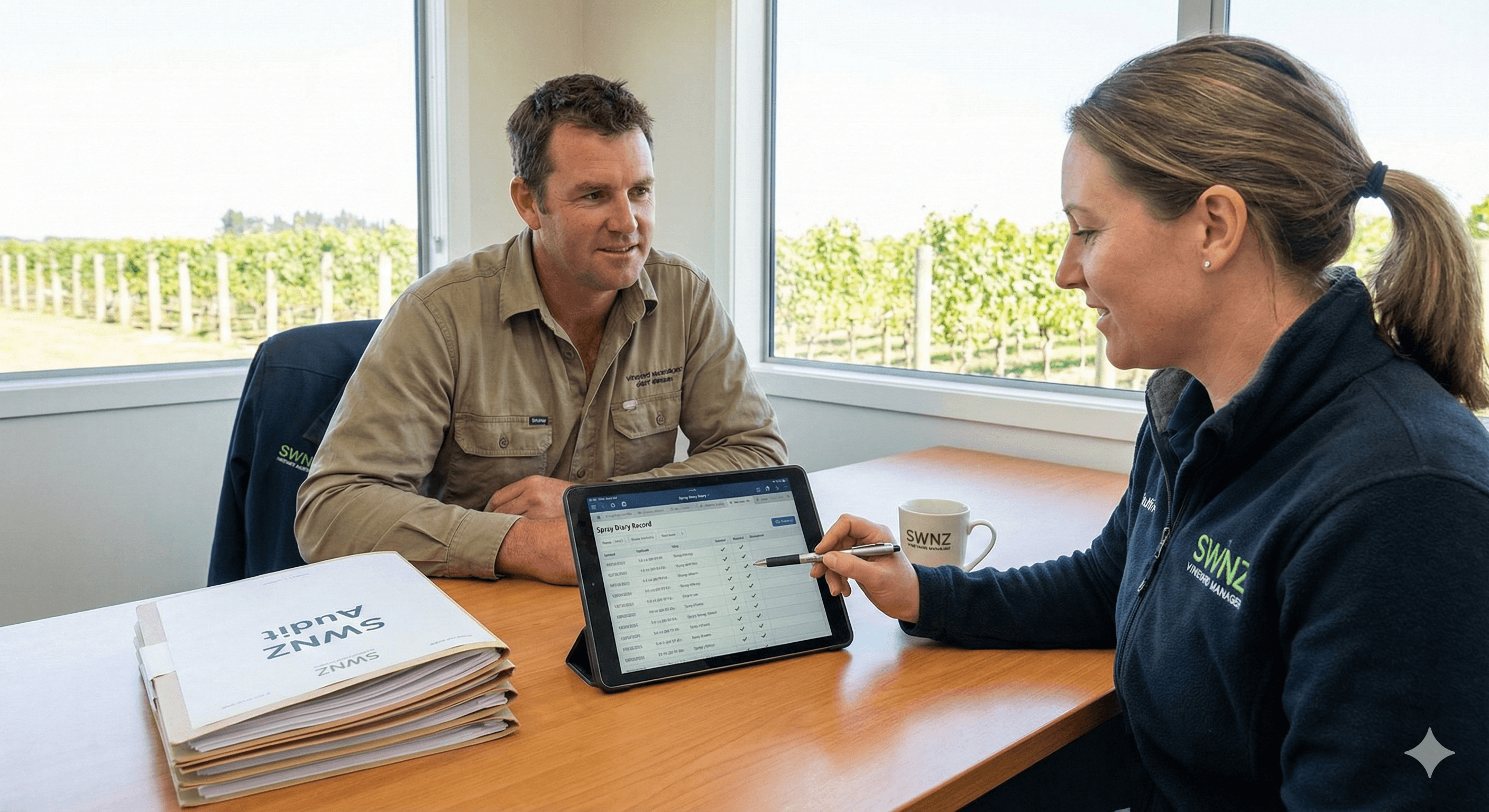
Sustainable Winegrowing New Zealand certification is table stakes for most commercial vineyards. The annual audit is part of the deal — an assessor reviews your records, walks your property, and confirms you're doing what you say you're doing.
For well-organised operations, audits are straightforward. For everyone else, they're a scramble to locate paperwork, reconstruct timelines, and explain gaps.
The difference usually comes down to how spray records are kept throughout the year, not how much preparation happens the week before.
What assessors are checking
SWNZ audits cover a lot of ground, but spray diary review follows a predictable pattern. Assessors want to see that every application is recorded with complete information: date, block, product, rate, operator, and equipment. They check that products are used according to label directions — right crop, right rate, right growth stage. They verify that withholding periods were observed before harvest. They look for evidence of resistance management through product rotation.
They're also checking for consistency. Do your spray records match your inventory movements? Do application dates align with weather records? Does the total product used make sense for the area treated?
None of this is designed to catch you out. It's designed to verify that the records you're keeping reflect what actually happened in the vineyard.
Common gaps that cause problems
Most audit findings aren't dramatic failures — they're small omissions that accumulated over the season. Weather conditions not recorded. Operator name missing. Growth stage left blank. Application rate written as "as per label" instead of the actual L/ha.
These gaps are easy to create and hard to fix retrospectively. Three months after an application, can you remember what the wind speed was? Can you reconstruct why you used a slightly different rate on one block?
The other common issue is timing. Spray records created days or weeks after application are less reliable than records created at the time. Auditors know this, and they look for it.
Making audit-ready the default
The goal isn't to prepare for audits — it's to make your normal record-keeping audit-ready by default. That means capturing complete information at the time of application, not filling in gaps later. It means recording what actually happened, not what the plan said should happen. It means storing records in a format that's easy to search, filter, and export when an assessor asks for specific information.
Paper diaries can do this, but they make it harder than it needs to be. When every field needs to be filled manually, shortcuts happen. When records live in a folder rather than a searchable database, finding specific applications takes time.
What we're building
Cordyn is designed around the principle that compliance documentation should be a byproduct of normal operations. When a spray operator records an application, the system captures everything SWNZ requires — not because the operator remembered to fill in every field, but because the interface is structured to collect complete information by default.
When an auditor asks to see all applications of a specific product, or all treatments on a specific block, or all late-season sprays within 30 days of harvest — that's a query, not a research project.
We're building for the reality that audits happen, and that the time to prepare for them is every day you're recording spray applications, not the week before an assessor arrives.